

Will future generations stop writing?
A Beginner’s Guide on Transforming Education in the Era of AI

As someone who values lifelong learning, I kicked off September by attending a UN conference on the impact of generative artificial intelligence (GenAI) on education and research. The conference was a discussion of varying levels of anxiety, enthusiasm, fear, and hope.
Some of the case scenarios presented included teachers excluding writing assignments in courses because they cannot identify AI input, GenAI being used to share better quality resources for educators around the world, or future generations forgetting how to write or employ critical thinking.
One speaker even pulled up Wall-E as an example of a worst case AI scenario. Though meant to lighten the mood of the session, the message was clear: whatever best practices are adopted will impact humanity as a whole.
What even is GenAI?
To start, there is no official definition for AI - even for AI experts. At best, it can be defined by its key characteristics: autonomy (ability to perform tasks in complex environments without constant user/human guidance) and adaptability (ability to improve performance by learning from experience).
Here’s a quick tech breakdown of key terms to know:
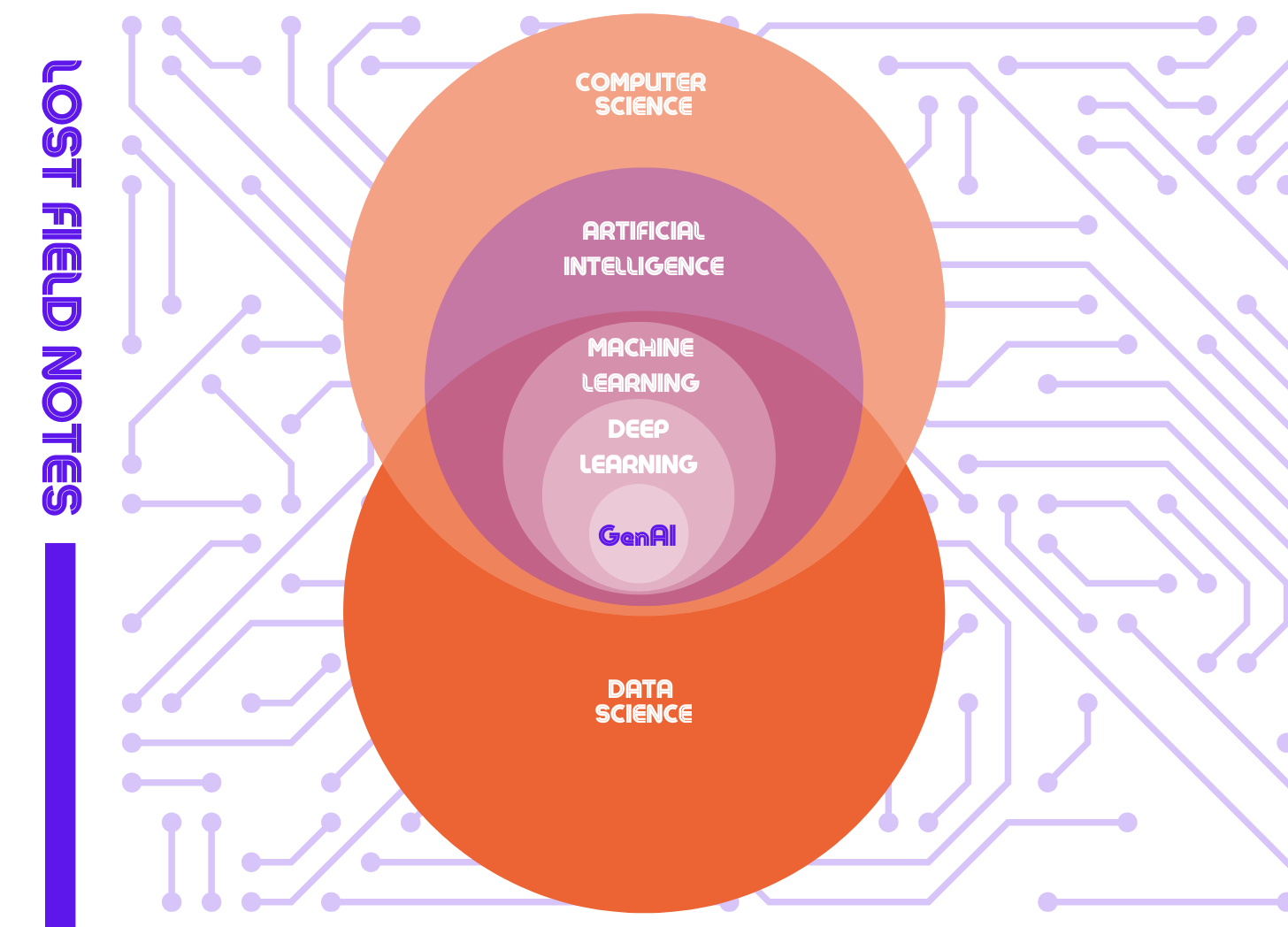
Machine Learning, a subfield of AI, refers to algorithms that learn from data to make predictions based on that data. Deep learning, a subfield of machine learning, refers to training computers to think “more like humans” using neural networks. GenAI is a subfield of deep learning (find out more and more).

Infographic on the relation of Generative AI (GenAI) to other fields. Created by Lost Field Notes 2023. Generative artificial intelligence (GenAI) is a type of AI that uses algorithms to create new and original content such as audio, code, images, text, simulations, and videos, rather than simply recognizing patterns or analyzing existing data.
Pros 👍: Opportunity to improve efficiency, accuracy, and creativity in a variety of industries such as advertising, gaming, marketing, and social media.
Cons 👎: Ethical concerns revolve around GenAI's potential use to create misleading or false content, such as deepfakes to damage someone’s reputation or fake news articles and phishing emails that can deceive people.
I recommend checking out Elements of AI - a free course curated by Google - if you want to learn more about the basics of artificial intelligence.
Potentially huge implications of GenAI for education
Since late 2022, GenAI tool ChatGPT has exponentially grown in popularity. Currently at 200 million active monthly users, the number of users is estimated to grow to 514 million in 2024. A deeper dive into user demographics reveals a gender imbalance (is this a digital literacy issue?): more than 60% of ChatGPT users are aged 18 to 34, with 61.52% of them male and 38.48% female. With the fast adoption of this type of tool comes the question of student engagement - how do you strengthen the motivation to learn if assignments can write themselves? How do you ensure equitable access to such tools?
It is also important to recognize that technology is not neutral and reflects only certain worldviews and ways of thinking. For instance, most AI companies are concentrated in only two countries, and only a handful of languages are currently used (10 out of 7000 according to UNESCO). Additionally, the vast majority of higher education online content is created in the Global North. What then can we do to make GenAI solutions inclusive for education in different countries?
GenAI tools have wide-ranging capacities for information processing and knowledge production, which is why policymakers and institutions need to quickly consider the long-term impact of GenAI on the creation, acquisition, and validation of knowledge.
Why, what, and how we learn: critical considerations for education in this new digital era phase.
The Pandemic brought about the largest disruption to education in history. Although connected technology supported the continuation of education for over 1.6 billion learners during school closures (early 2020 to late 2022), many more were left behind.
Exclusion soared and inequities widened. Achievement levels fell, even for those with access to distance learning. Educational experiences narrowed. Physical and mental health declined. Privatization accelerated, threatening education’s unique standing as a public good and human right. Invasive surveillance endangered the free and open exchange of ideas and undermined trust. Automation replaced human interactions with machine-mediated experiences. And technology production and disposal placed new strains on the environment.
Source: UNESCO (2023). An ed-tech tragedy? Educational technologies and school closures in the time of COVID-19, Summary: 18. Available for download here.
The pandemic also highlighted that beyond academic achievement, schools are a ground for social interactions and play a huge role in developing socio-emotional wellbeing, our humanness if you will. Philosophically, we might want to think about defining what basic skills every human should know how to do without technology: (soft) empathy, kindness, honesty / (hard) public speaking, swimming, riding a bike, reading a map, drawing a picture, writing a message, growing a plant, cooking a meal, building a shelter, etc.
One possible outcome for future education strategy might be the adoption of automated tutoring (powered by GenAI) combined with individual learning (similar to mentoring). Based on aptitude assessments and student personal choice, specialized teachers would be assigned to mentor small groups in person, with opportunities to meet up with bigger groups for activities to develop the “key skills that make us human”.
I am full of questions about what’s to come next and would love to hear your thoughts!
Thanks for reading Lost Field Notes’ Substack! Subscribe for free to receive new posts and support my work.